The 8 Best Cycling Routes in Scotland: Highlands to Islands
Eight of Scotland's best cycle routes, from the 516-mile North Coast 500 to a weekend loop of Arran, with distance, days and traffic-free share for each.
Quick links
Don't want to read all this?
We've planned 800+ cycling trips. Send your dates, fitness and group size — we'll map the route and book every night.


Scotland's best cycling follows the water. You ride beside sea lochs and canals, cross causeways from island to island and climb over passes to the next glen. In late June the sun sets after 10.30pm in Inverness, so a long day in the saddle still ends in daylight.
The routes here run from the 516-mile North Coast 500 to the 57-mile coast road around Arran. Six are long-distance routes, one is an island loop, and the Cairngorms are a region of forest trails around Aviemore. They are numbered for easy reference, not ranked.
Most of them start at a railway station or a ferry pier, so you rarely need a car to reach them. Bikes travel free on ScotRail trains and CalMac ferries once you book a space.
The Best Cycling Routes in Scotland
Water shapes every route below: sea lochs on the North Coast 500, two canals on the Caledonia Way, causeways in the Hebrides and three lochs in a row in the Great Glen.
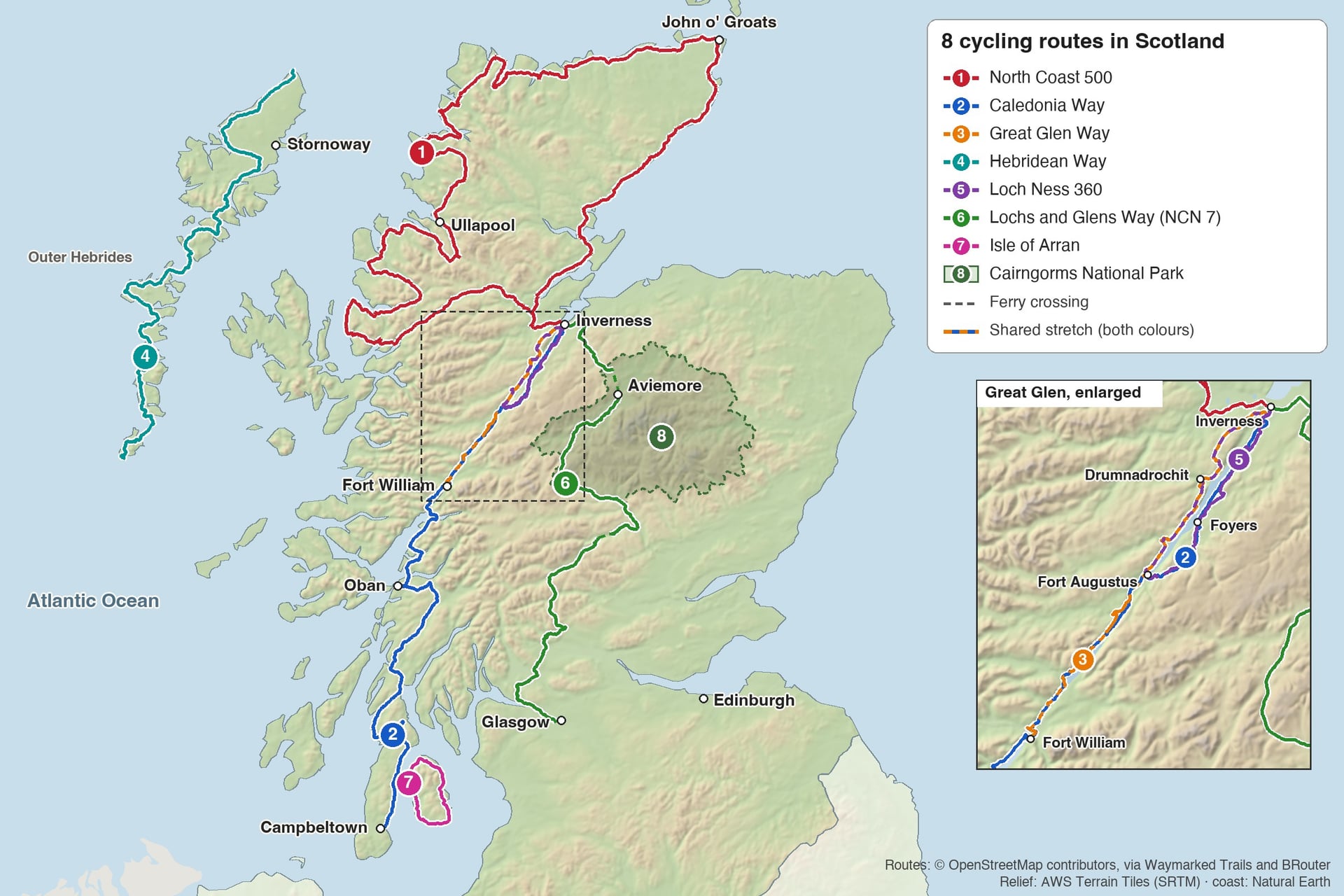
The routes run from a 57-mile island loop to the 516-mile North Coast 500, and from 0.2% traffic-free in the Hebrides to about a third on NCN 7.
Route | Distance | Days | Traffic-free | Best for |
North Coast 500 | 516 mi (830 km) | 7 to 10 | None | Mountain passes and empty coast roads |
Caledonia Way | 234 mi (377 km) | 5 to 7 | 26.7% | Sea lochs, canals and castles on a signed route |
Great Glen Way | 75 mi (121 km) | 2 to 4 | Mostly | A first multi-day ride on a gravel bike |
Hebridean Way | 185 mi (298 km) | 5 to 7 | 0.2% | Island-hopping by causeway and ferry |
Loch Ness 360 | 80 mi (129 km) | 3 to 4 | Mostly | A mountain-bike loop with no transfer |
Lochs and Glens Way | 214 mi (344 km) | 4 to 6 | 34.1% | Two national parks with a railway alongside |
Isle of Arran | 57 mi (92 km) | 1 to 2 | None | A weekend loop from Glasgow |
Cairngorms | Day rides of 7 to 66 mi | 2 to 4 | Forest trails | Family rides and forest loops from one base |
Most climbing: the North Coast 500, with about 10,500 m of elevation gain and the 626 m Bealach na Bà
Lowest high points: Arran (about 200 m) and the Hebridean Way (about 205 m), although the Atlantic wind makes up for it on the islands
Most traffic-free long route: the Lochs and Glens Way (34.1%), ahead of the Caledonia Way (26.7%)
Shortest trip: Arran in one long day, or the Great Glen Way in 2 to 4 days
1. North Coast 500
Distance: 516 miles (830 km), a loop from Inverness
Typical days: 7 to 10 days
Start and finish: Inverness station
Surface: public roads, single-track with passing places in the west and north
Traffic-free: none
Highest point: 626 m on the Bealach na Bà, above Applecross
Best for: fit road riders who want mountain passes and empty coast roads
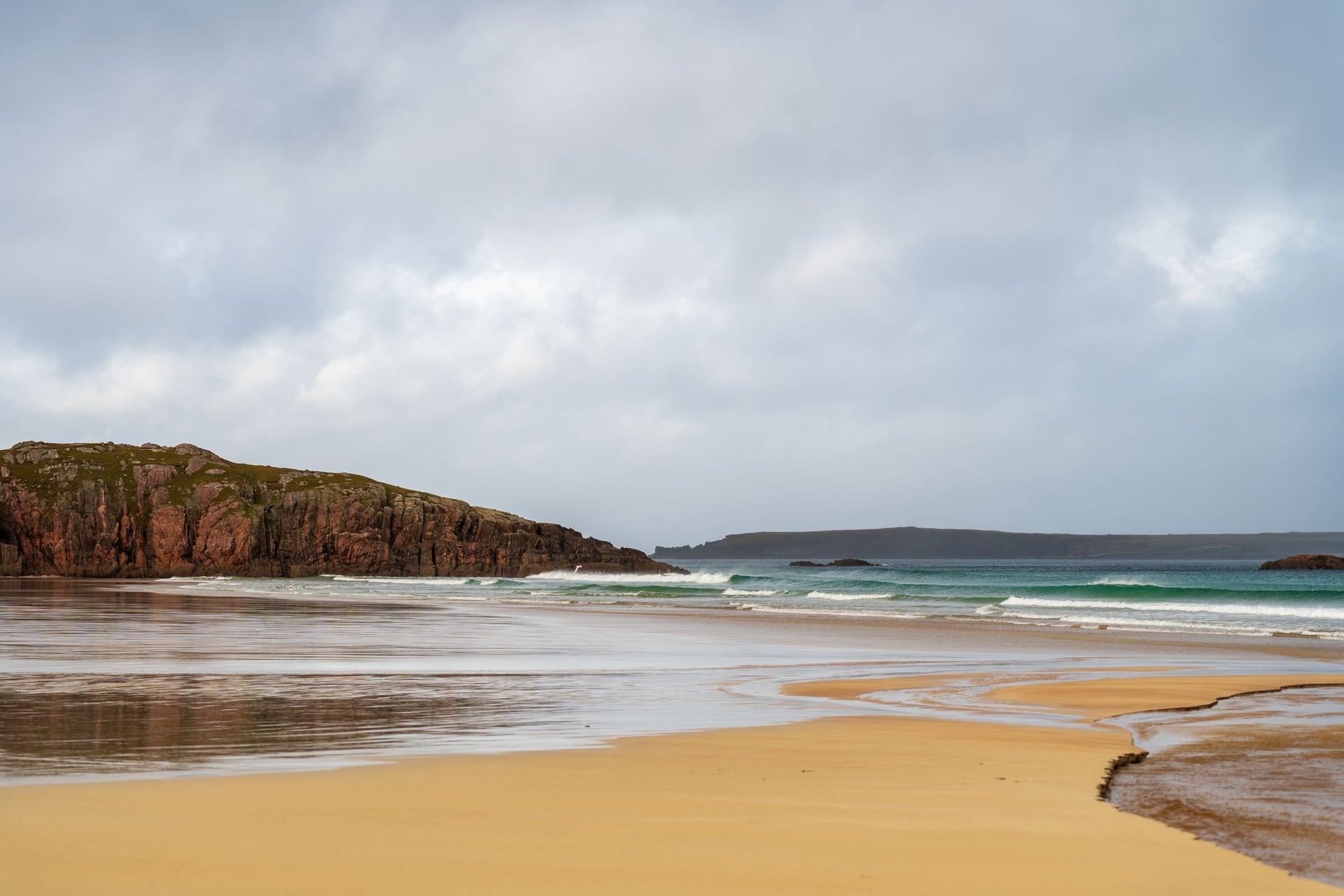
Launched in 2015 as a touring route for drivers, the North Coast 500 loops round the far north from Inverness. On a bike it carries the most climbing of any route here, about 10,500 m, and most riders go clockwise so the west coast comes first.
The Bealach na Bà climbs from sea level at Tornapress to 626 m in about 9 km, with ramps of 20%. Beyond it the road rises and falls round every sea loch through Torridon and Assynt, where villages can sit 20 miles apart.
The hardest day, Ullapool to Scourie through Assynt, has about 2,190 m of elevation gain. Along the top of Scotland the road then drops to the beaches between Durness and Bettyhill.
Heading south, the east coast back to Inverness is faster, on two-lane roads past Dunrobin Castle, with about 650 m of elevation gain in the last 67 miles from Brora.
Full guide: North Coast 500 cycle route, stage by stage
2. Caledonia Way
Distance: 234 miles (377 km), National Cycle Route 78
Typical days: 5 to 7 days
Start and finish: Campbeltown (no railway) to Inverness station; stations at Oban and Fort William on the way
Surface: 85% asphalt, the rest firm or loose gravel
Traffic-free: 26.7%, mostly between Oban and Fort Augustus
Highest point: about 390 m, on the B862 above Fort Augustus
Best for: sea lochs, canals and castles on a signed route
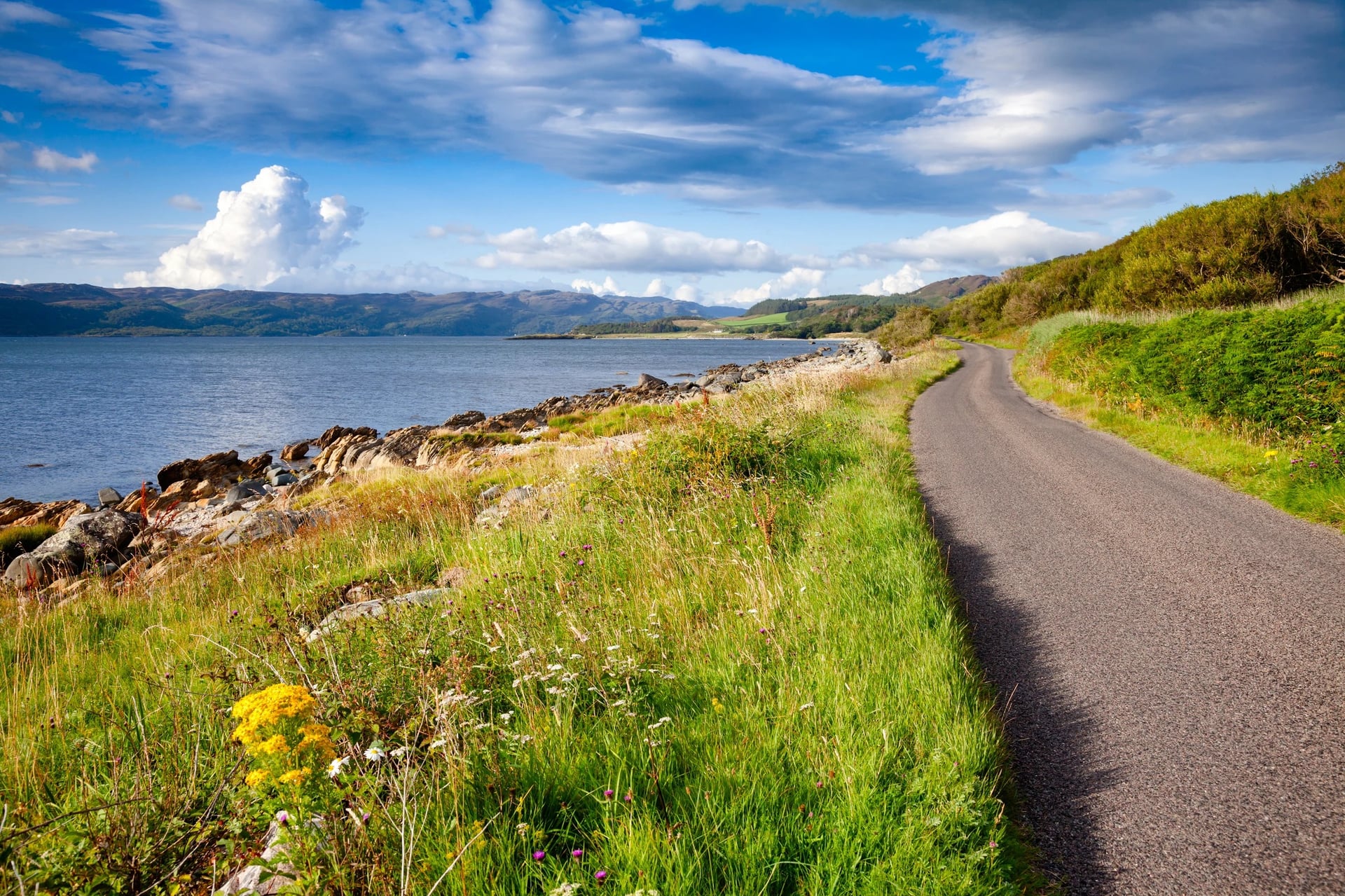
From Campbeltown the Caledonia Way follows the east coast of Kintyre for 38 miles to Tarbert, then the single-track Kilberry road above Loch Caolisport. The first three stages are the hilliest: they carry about two-thirds of the route's 5,000 m of elevation gain, with about 1,200 m on some days.
After the 9-mile Crinan Canal and the standing stones of Kilmartin Glen, the route follows the west shore of Loch Awe to Oban. North of Oban an old railway path runs beside Loch Linnhe to Ballachulish, and most of the 49 miles to Fort William are traffic-free.
Two small ferries, at Corran and Camusnagaul, take you to Fort William, and the Camusnagaul boat does not sail on Sundays, when the detour round Loch Eil adds 20 miles. After Fort Augustus, Route 78 runs along the quiet south-east side of Loch Ness through Foyers and Dores.
Full guide: Caledonia Way cycle route
3. Great Glen Way
Distance: 75 miles (121 km), Fort William to Inverness
Typical days: 2 to 4 days
Start and finish: Fort William station to Inverness station
Surface: canal towpath, forest road and quiet lanes, with short rough footpaths
Traffic-free: most of the route
Highest point: 380 m, in the Abriachan woods above Loch Ness
Best for: a first multi-day ride on a gravel or hybrid bike
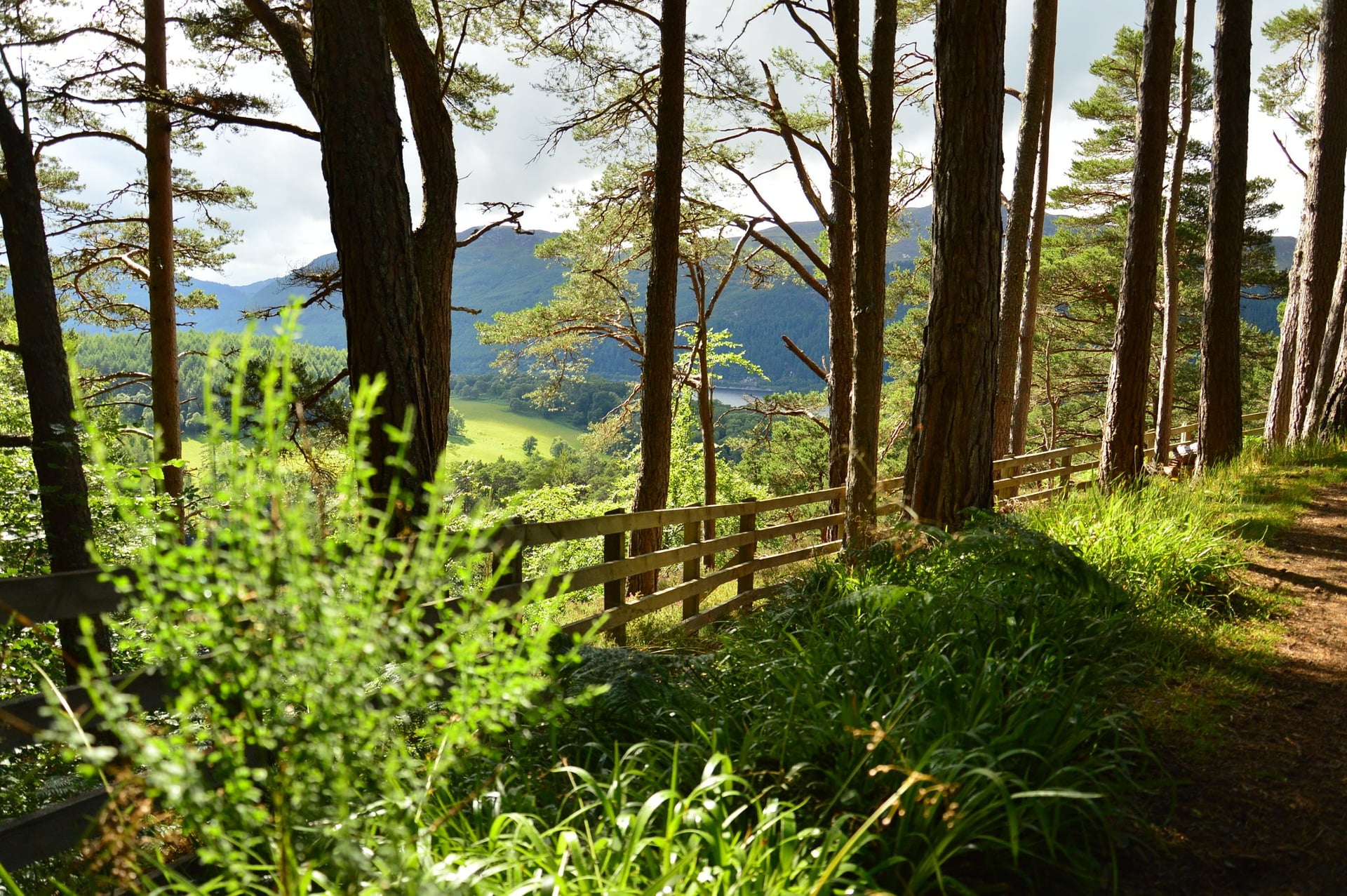
The Great Glen is a fault line that cuts the Highlands in two, and the Great Glen Way follows all 75 miles of it. The first 35 miles are close to flat, on the Caledonian Canal towpath past Neptune's Staircase and on forest roads beside Loch Lochy and the old railway along Loch Oich.
After Fort Augustus the forest roads climb high above Loch Ness, with about 850 m of elevation gain between Invergarry and Drumnadrochit and 14 miles with no village after Invermoriston. Riders take the low routes, because the walkers' high routes, which reach 434 m, have steep sections that are unsuitable for bikes.
Until June 2029 a signed diversion takes the route round the Coire Glas hydro works at Loch Lochy.
Full guide: Cycling the Great Glen Way
4. Hebridean Way
Distance: 185 miles (298 km), Vatersay to the Butt of Lewis
Typical days: 5 to 7 days
Start and finish: Vatersay, by ferry from Oban to Castlebay, to the Butt of Lewis; ferries home from Stornoway
Surface: quiet roads, 100% asphalt, some of it single-track
Traffic-free: 0.2%
Highest point: about 205 m, on the A859 in North Harris
Best for: island-hopping by causeway and ferry
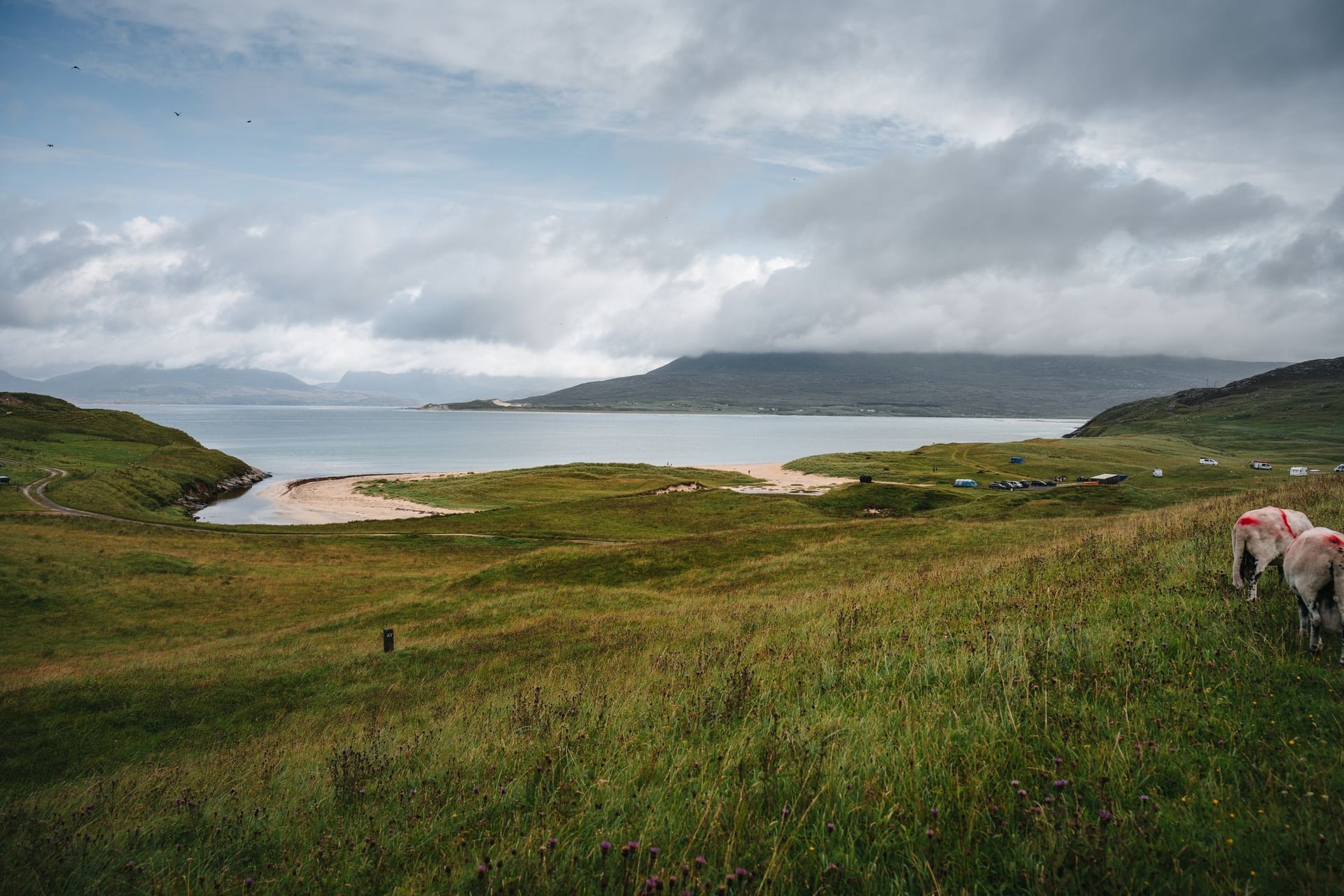
Ten islands of the Outer Hebrides are linked by the 185-mile Hebridean Way, using six causeways and two ferries. It runs from Vatersay through Barra, the Uists, Benbecula and Harris to the northern tip of Lewis, past white beaches and the flower-rich grassland called machair.
The climbing is modest, with a highest point of about 205 m in North Harris, but the islands are treeless and open to the Atlantic wind. Walk Wheel Cycle Trust notes that riders usually go south to north, with the prevailing wind behind them.
Visit Outer Hebrides lists Hebridean Way pit stops for food, water and repairs. The two ferries run from Barra to Eriskay and from Berneray to Leverburgh, and their timetables change with the season.
5. Loch Ness 360 Trail
Distance: about 80 miles (129 km), a loop from Inverness
Typical days: 3 to 4 days
Start and finish: Inverness Castle, or any point on the loop
Surface: forest track, rough trail and minor roads, with steep sections and 1 mile on the B852 into Dores
Traffic-free: most of the route
Highest point: about 425 m, south of Loch Ness above Fort Augustus
Best for: mountain bikers who want a loop with no transfer
Two waymarked trails make up the Loch Ness 360° Trail: the Great Glen Way on the north shore and the South Loch Ness Trail on the other side. The loop is about 80 miles long, and the trail's own site calls it suitable for mountain bikes, over 3 to 4 days.
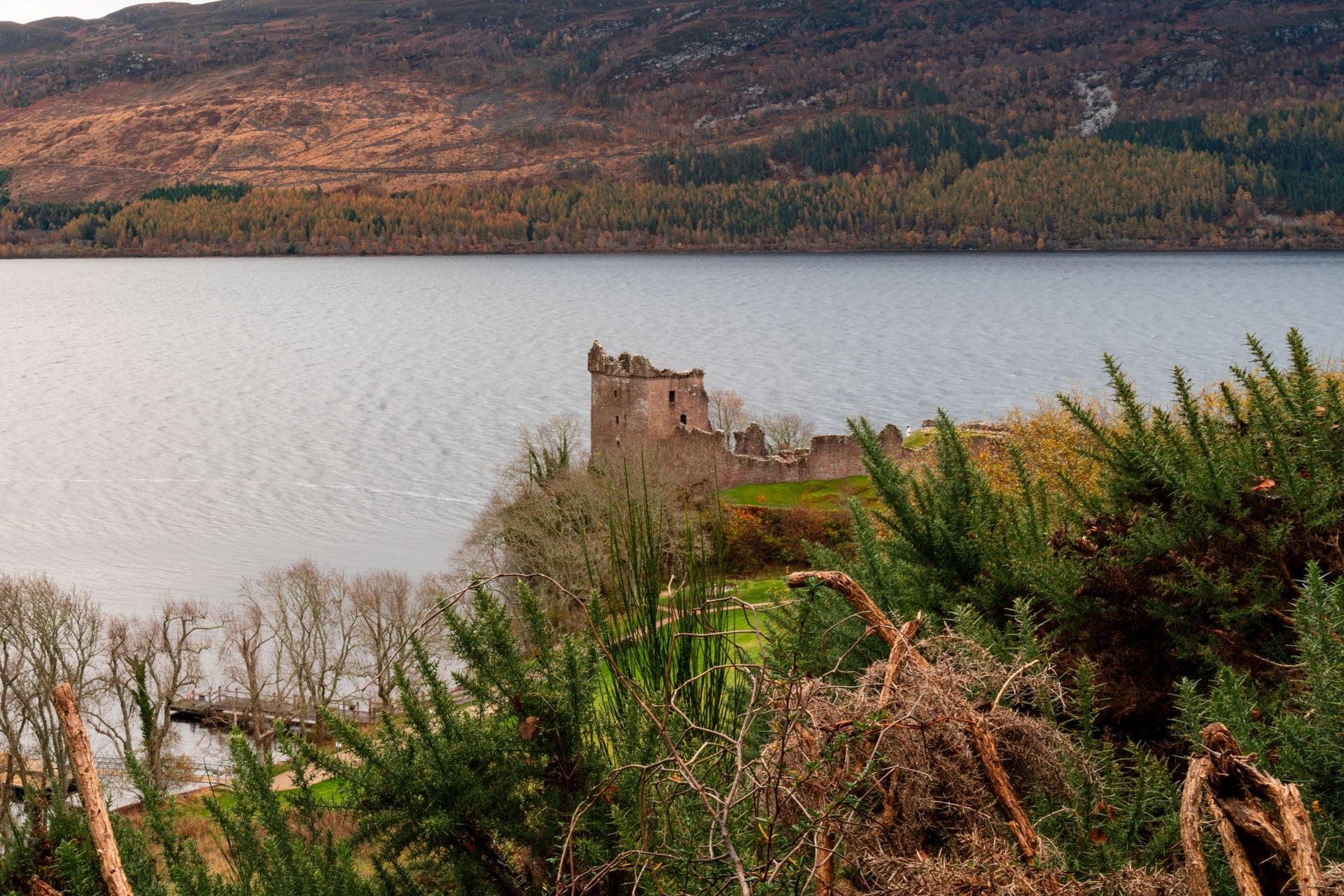
On the north shore the 18-mile first section from Inverness passes Urquhart Castle, and riders take the low route options between Drumnadrochit and Fort Augustus. The south side is quieter, on forest tracks and minor roads high above the loch, including a zig-zag road near Inverfarigaig known locally as the corkscrew.
The trail between Foyers and Inverfarigaig is closed to bikes, so riders take the alternative through Glen Lia. The trail is split into six sections, and each takes about half a day by bike.
6. Lochs and Glens Way (NCN 7)
Distance: 214 miles (344 km), Glasgow to Inverness
Typical days: 4 to 6 days
Start and finish: Glasgow to Inverness; Highland Main Line stations from Pitlochry to Aviemore on the way
Surface: 86% asphalt, the rest firm or loose gravel
Traffic-free: 34.1%
Highest point: about 460 m, at the Pass of Drumochter
Best for: two national parks, with a railway alongside for the way home
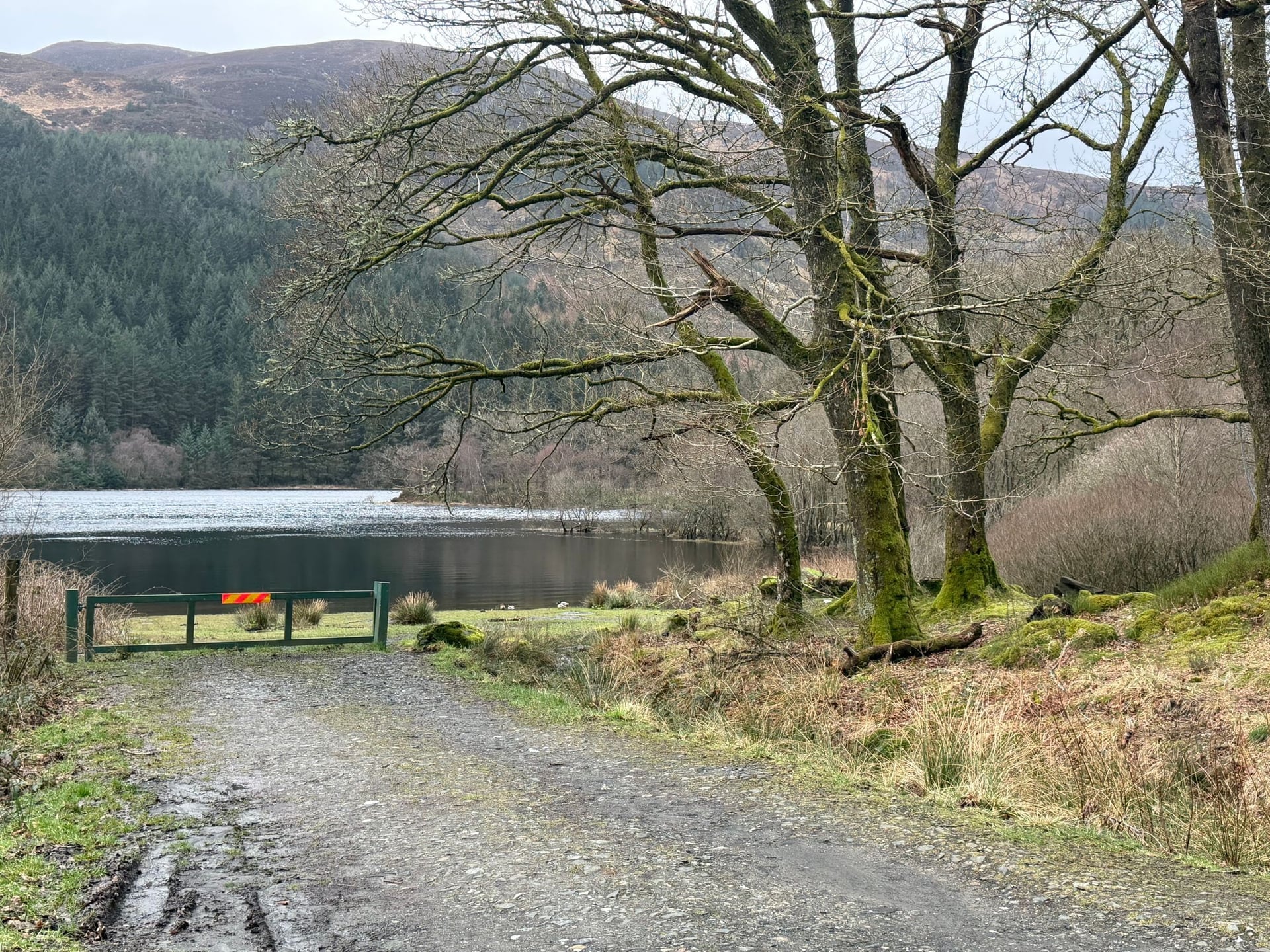
National Cycle Route 7 runs 214 miles from Glasgow to Inverness, through Loch Lomond and the Trossachs National Park and the Cairngorms. Walk Wheel Cycle Trust counts the traffic-free path through the Pass of Drumochter, at about 460 m, among the highlights of its Lochs and Glens Way.
North of Glasgow the route passes Loch Venachar, Loch Lubnaig and Loch Tay, then crosses the hills to Pitlochry. Walk Wheel Cycle Trust puts the whole ride at 18 hours in the saddle.
From Pitlochry the railway runs beside the route for the last 95 miles, with stations at Blair Atholl, Dalwhinnie, Kingussie and Aviemore.
At Aviemore, about 35 miles before Inverness, the route reaches the forest trails of the Cairngorms, entry 8 below.
7. Isle of Arran
Distance: about 57 miles (92 km), a loop of the coast road from Brodick
Typical days: 1 to 2 days
Start and finish: Brodick, by CalMac ferry from Ardrossan or Troon
Surface: the A841 coast road, all asphalt
Traffic-free: none
Highest point: about 200 m, on the climb between Sannox and Lochranza
Best for: a weekend loop within reach of Glasgow by train and ferry
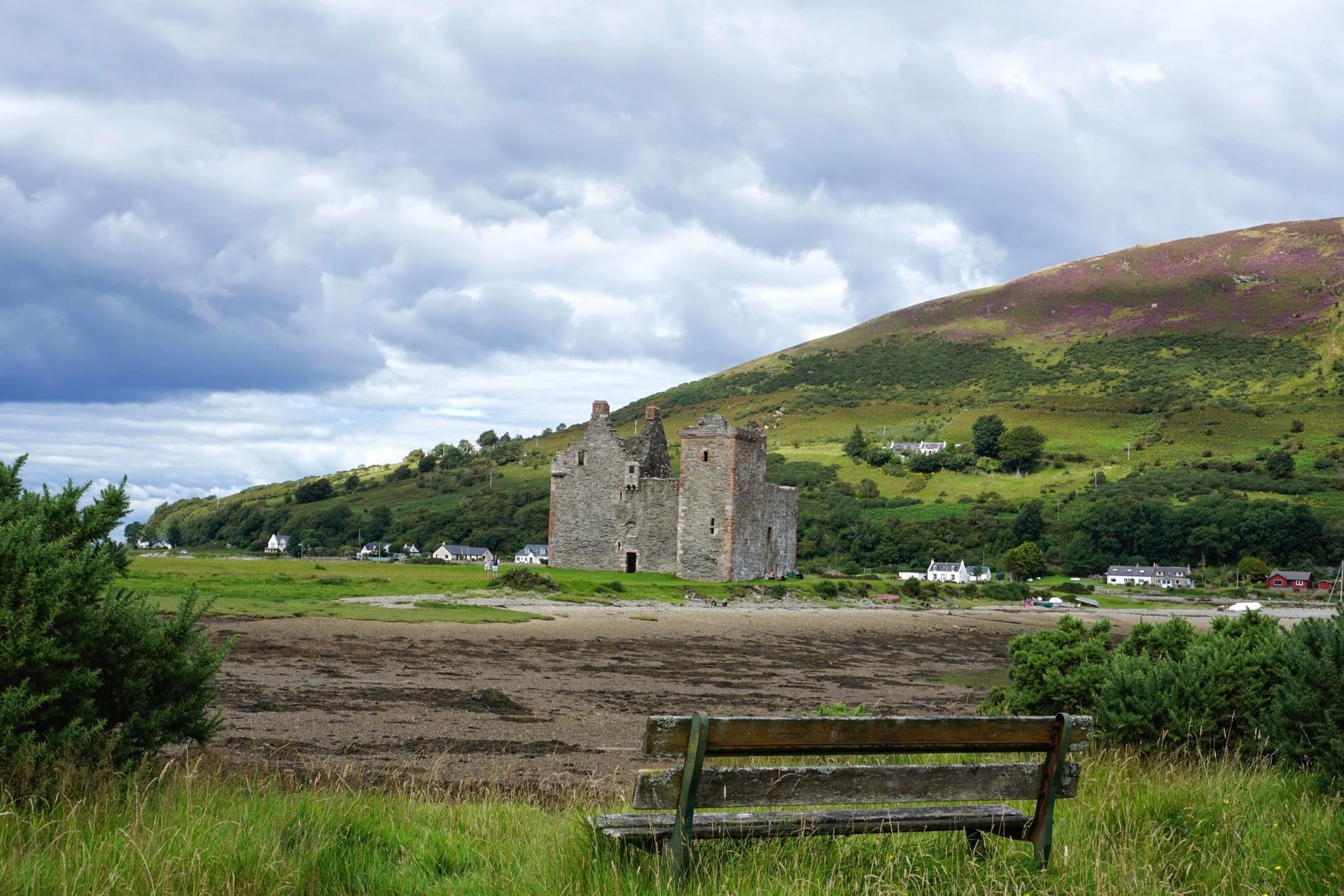
People often call Arran Scotland in miniature, with granite mountains in the north and lower farmland in the south. VisitArran puts the full coast road at about 57 miles, with two big climbs and many smaller ones.
Heading north from Brodick, the road climbs over the hills between Sannox and Lochranza, to about 200 m, the highest point of the loop. The west and south sides are lower, past Machrie Bay and the villages of Lagg, Whiting Bay and Lamlash.
From Lochranza a small CalMac ferry crosses to Claonaig in Kintyre in 30 minutes, and it links Arran to the Caledonia Way 28 miles north of Campbeltown.
8. Cairngorms National Park
Distance: day rides of 7 to 66 miles (11 to 106 km) from Aviemore
Typical days: 2 to 4 days of day rides from one base
Start and finish: Aviemore station
Surface: forest track, gravel path and quiet roads
Traffic-free: the Old Logging Way and the Rothiemurchus trails
Highest point: about 635 m, at the top of the Cairngorm ski road
Best for: family rides and forest loops without moving hotel
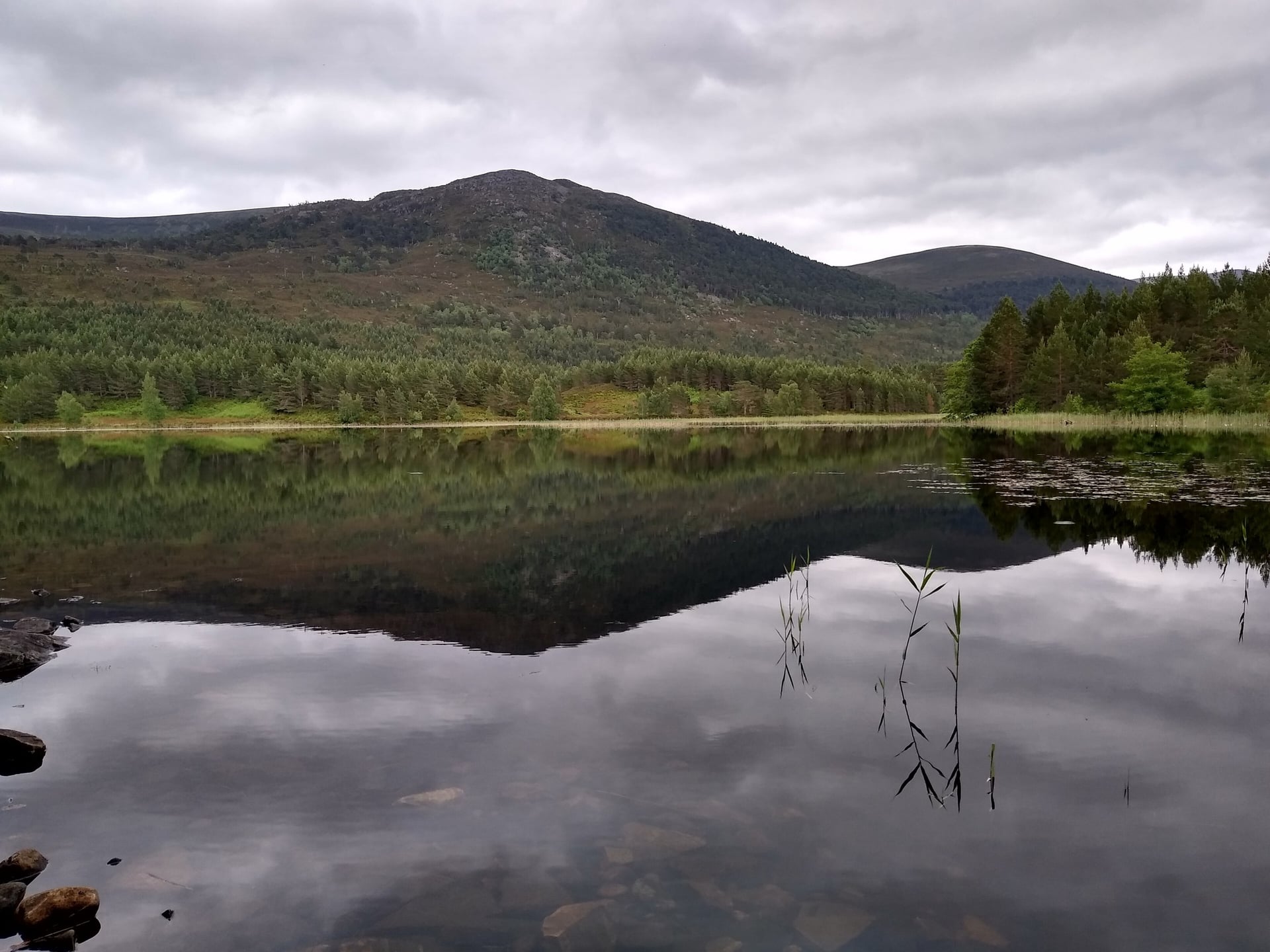
Covering 4,528 sq km, the Cairngorms are the UK's largest national park, and Aviemore is the cycling base. NCN 7 and the Speyside Way both pass through the town, and most day rides start from the station.
The Old Logging Way runs 12 km each way, traffic-free, to An Lochan Uaine beyond Loch Morlich. The Rothiemurchus estate's Three Lochs Trail is a 10.8 km loop past the castle in Loch an Eilein, and road riders climb the ski road to Cairngorm. The Speyside Way runs 31.4 km from Aviemore to Newtonmore.
Check the forest paths before you set off, because the right of way beyond Ryvoan bothy was still closed in October 2026, after the July wildfire.
Full guide: Cycling in the Cairngorms
How Hard Is Cycling in Scotland?
Effort in Scotland comes from short, steep climbs, wind and rain more than from altitude: none of these routes goes above 640 m.
Hills and Wind
The steepest roads are on the west coast, where the North Coast 500 is at its hardest. The Bealach na Bà reaches 20%, and two days between Lochcarron and Scourie each have more than 2,000 m of elevation gain.
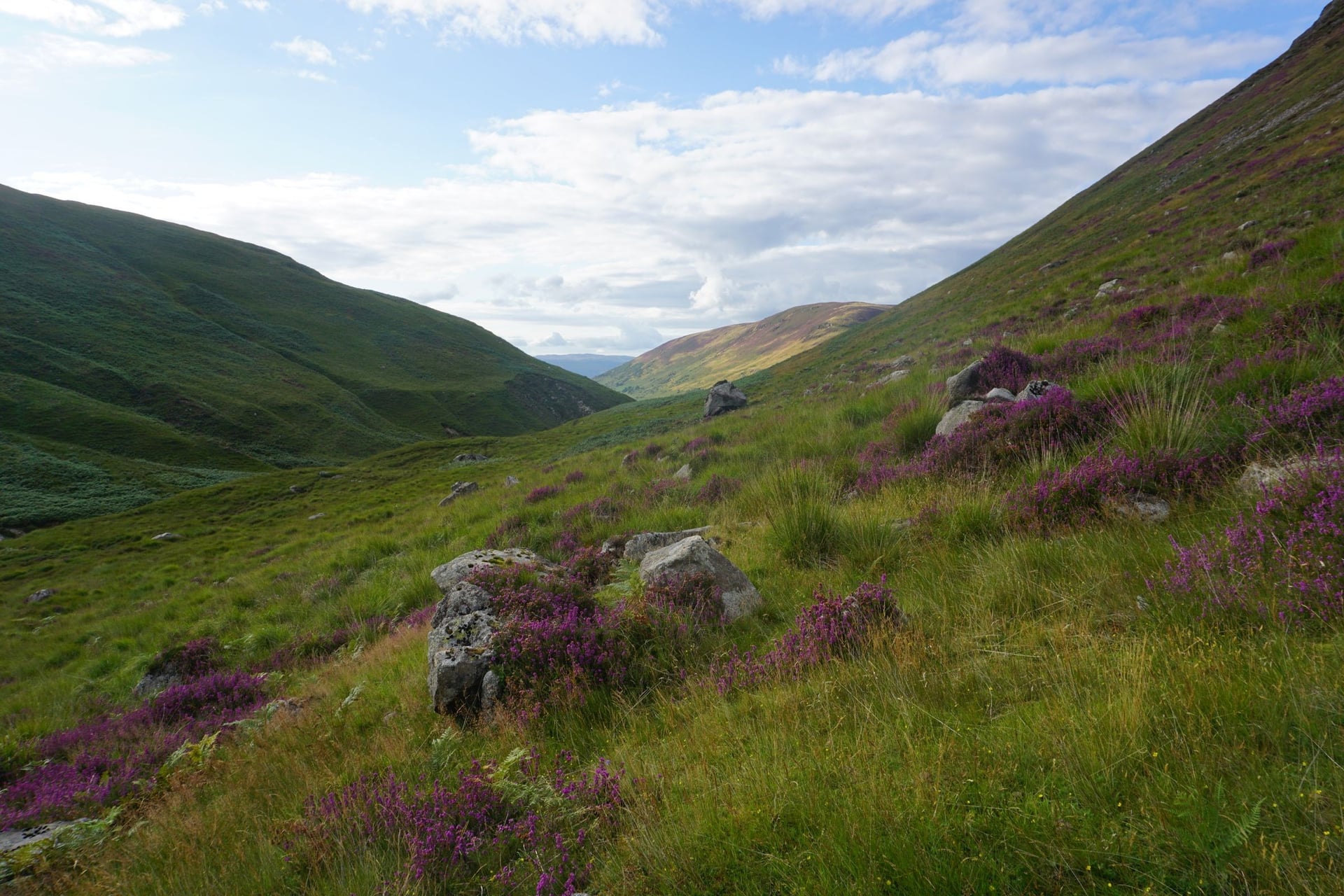
Elsewhere the climbs are longer and steadier, like the forest roads above Loch Ness and the pull to Drumochter on NCN 7. Arran's coast road tops out at about 200 m between Sannox and Lochranza.
On the Hebridean Way the highest point is only about 205 m, but nothing shelters you from the Atlantic wind, so plan shorter days when it blows.
Single-Track Roads and Passing Places
Much of the North Coast 500, the Hebridean Way and the Kilberry road on the Caledonia Way is single-track: one lane, with passing places marked by white signs. On these Highland roads the Highway Code sets the rules for using them.
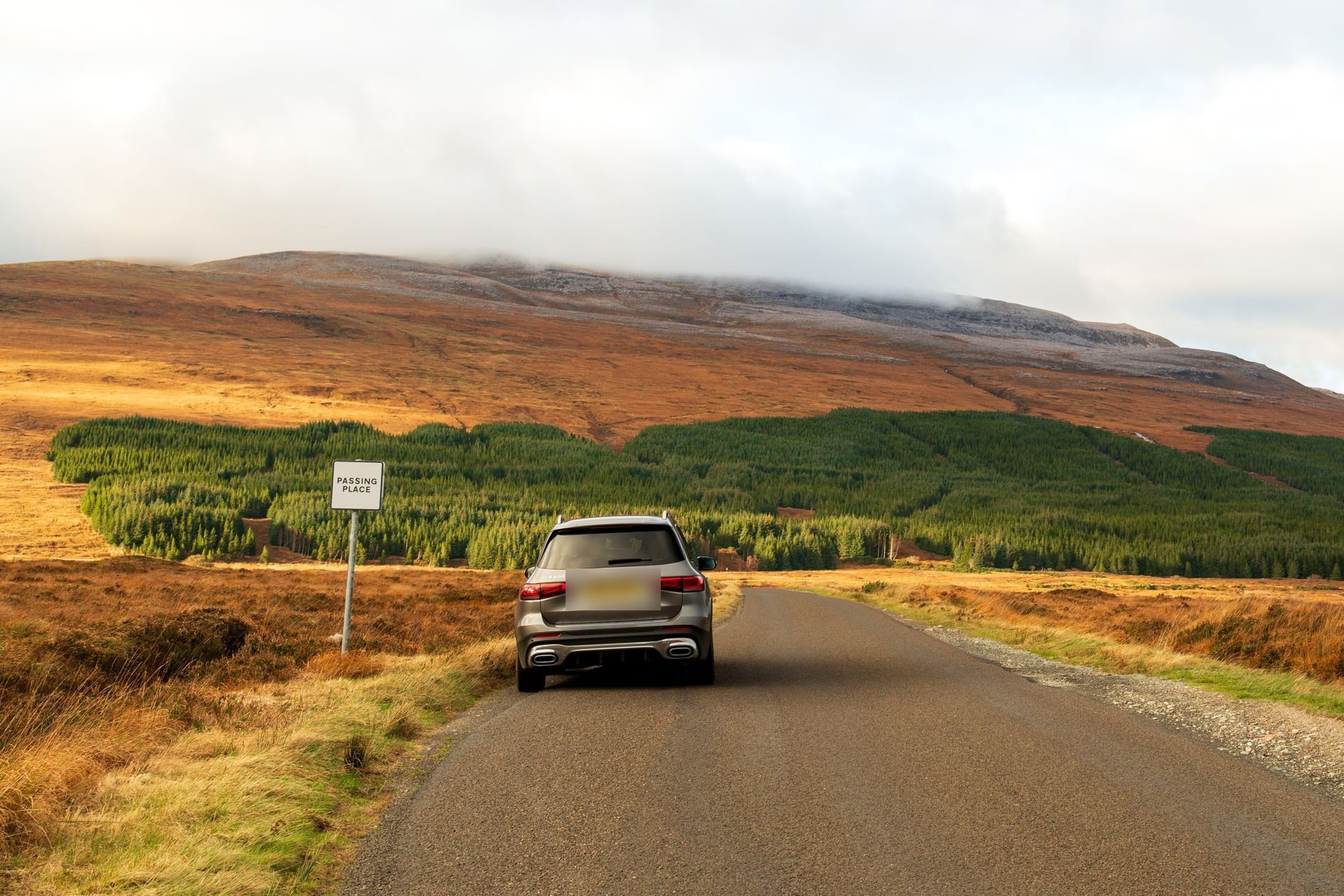
Pull in to let traffic pass: rule 155 says to pull into a passing place on your left, or wait opposite one on your right
Let drivers behind you overtake: the same rule applies when a driver behind wants to pass
Give way uphill: rule 155 asks road users to give way to traffic coming uphill whenever they can
Never stop in a passing place: rule 156 says not to park in one, so stop for photos elsewhere
Waymarking and Navigation
National Cycle Network routes, including the Caledonia Way and NCN 7, carry blue signs with the route number. The Great Glen Way and the Loch Ness 360 are waymarked trails, and the North Coast 500 has no cycle signs at all, only brown tourist signs in places.
Signs go missing in forests and on moorland, so carry the GPX file and an offline map. The Loch Ness 360 team advises buying a map and not relying on waymarkers alone, and phone signal is patchy in the north-west Highlands and the Hebrides.
Best Time to Cycle in Scotland
The touring season runs from May to September, when the days are long and village beds and cafés are open.
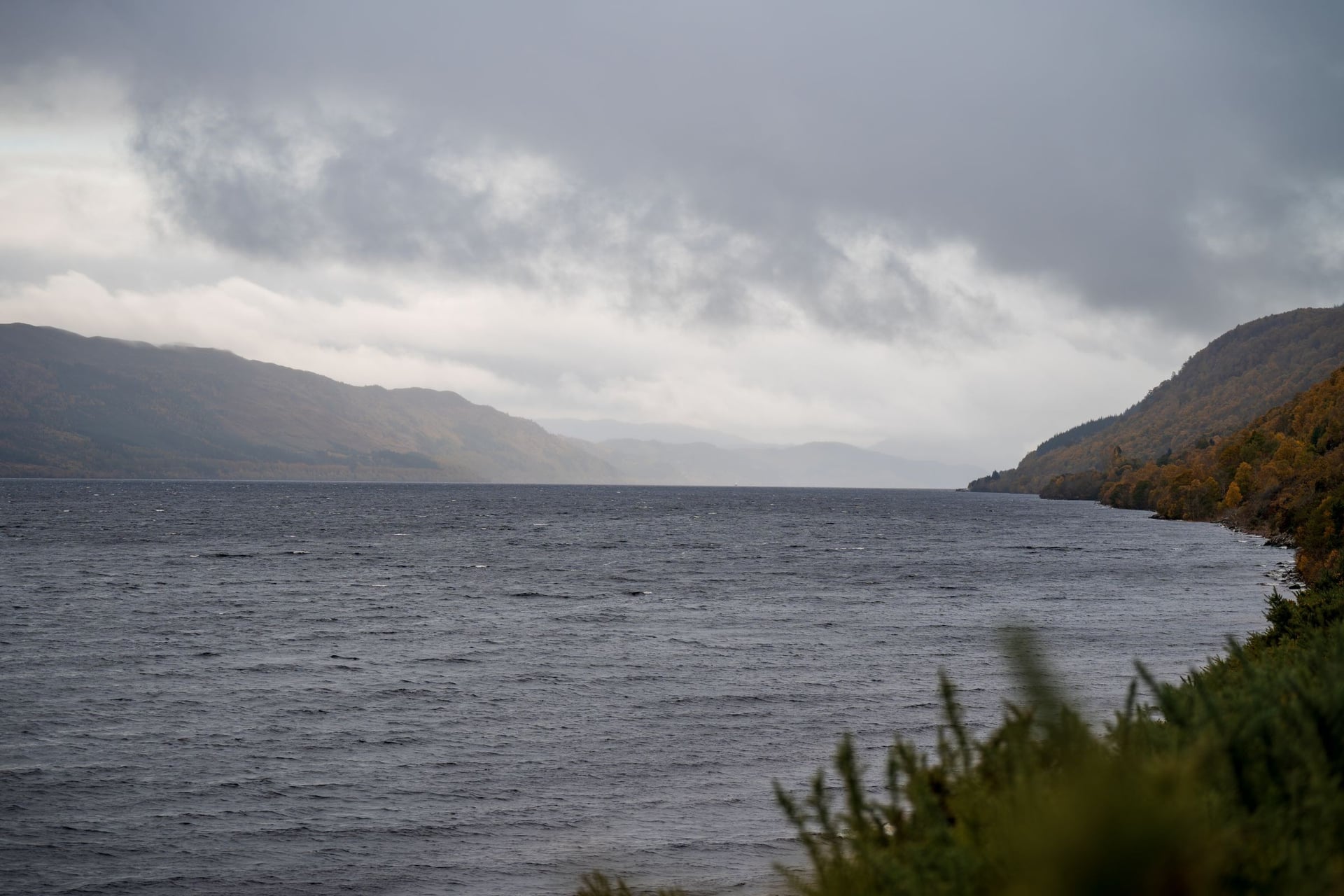
April: about 12 °C by day at Fort Augustus and Inverness, with quiet roads, but some cafés and guesthouses are still closed
May: the sunniest month, with about 163 hours of sunshine at Fort Augustus and 184 at Inverness
June: the longest days, with about 18 hours of daylight in Inverness at midsummer; midges start to bite on still evenings
July and August: the warmest months, at 18 to 19 °C by day, and the busiest roads and beds, above all on the North Coast 500
September: still 16 °C by day and quieter, with about 13 hours of daylight by mid-month, but 105 mm of rain at Fort Augustus
October to March: short, wet days, with 110 to 190 mm of rain a month at Fort Augustus and under 7 hours of daylight in Inverness at midwinter
Rain falls far more often in the west. Fort Augustus, on Loch Ness, records 1,359 mm a year, while Inverness, about 30 miles to the north-east, gets 755 mm, so the Great Glen is almost twice as wet.
For most riders, late May, June and September are the best months, with long days and fewer people than in the school holidays. By October the first snow can reach the Cairngorm tops above Aviemore, and many village cafés close for the winter.
Know Before You Arrive
Most trips here begin with a train or a ferry, so book the bike space when you book your own seat.
Getting to the Start With a Bike
Bikes travel free on ScotRail trains, but you must reserve a bike space on the Highland lines to Inverness, Fort William and Oban. Inter7City trains to Inverness, which stop at Pitlochry and Aviemore, carry up to six bikes, and the Highland Explorer carriage on the West Highland Line carries 20.
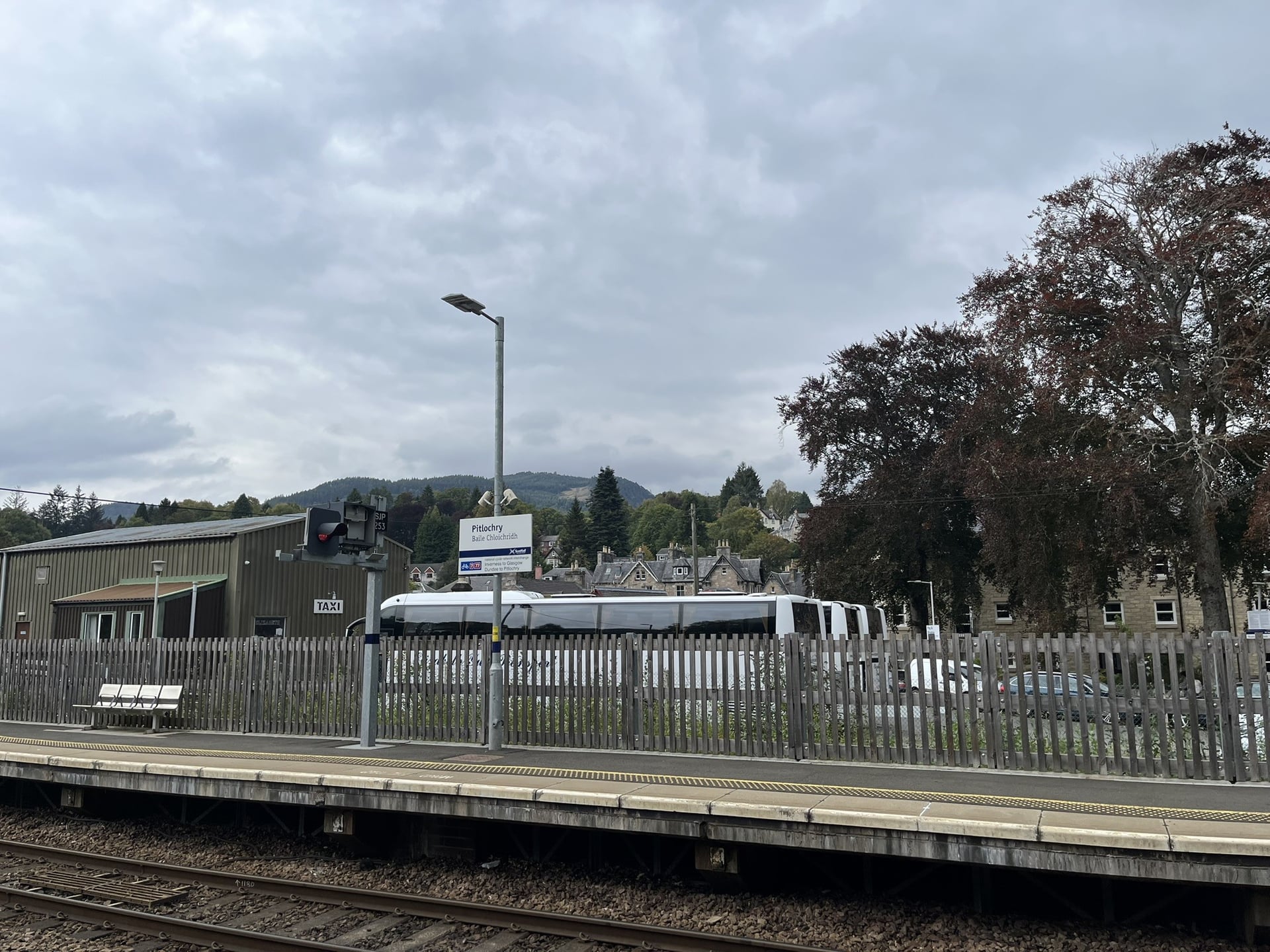
Route | Start | Nearest station or port | Bikes |
North Coast 500, Loch Ness 360 | Inverness | Inverness station | Free; reservation needed |
Caledonia Way | Campbeltown | No railway; Citylink coach 926 from Glasgow | One bike space; book with your seat |
Great Glen Way | Fort William | Fort William station | Free; reservation needed |
Hebridean Way | Vatersay | Oban station, then the CalMac ferry to Castlebay | Free on the ferry; add the bike to your booking |
Lochs and Glens Way | Glasgow | Glasgow Queen Street or Central | Free; reservation needed on Highland trains |
Isle of Arran | Brodick | Ardrossan Harbour or Troon, then the CalMac ferry | Free on the ferry; add the bike to your booking |
Cairngorms | Aviemore | Aviemore station | Free; reservation needed |
The coach to Campbeltown takes from 4 hours 5 minutes. At the far end of the Hebridean Way, the ferry from Stornoway lands at Ullapool, and Ullapool has no railway station, so plan the ride or a transfer to Inverness.
Where to Sleep
Beds are thinnest in the north-west, on the islands and along the Kilberry road, so book the remote nights first, months ahead for July and August.
Hostelling Scotland: most hostels have dorms of 4 to 8 beds; Glen Nevis and Inverness open all year, and they and Oban have secure bike storage
Gatliff hostels: simple hostels on the Hebridean Way at Berneray (21 beds) and Howmore on South Uist (16 beds), open all year, with no bookings; bring a sleeping bag or hire a sheet bag at the hostel
B&Bs and inns: the usual choice in small villages, but many have only a few rooms
Wild camping: legal under the Scottish Outdoor Access Code for small groups, for two or three nights in one place
Food, Shops and Bike Repairs
Shops and cafés thin out quickly in the north-west and on the islands, so carry a day's food on the remote stretches.
North Coast 500: gaps of up to 36 miles between shops, and no bike shop on the west coast since Ullapool's hire and repair shop closed in 2025
Caledonia Way: no café or shop on the Kilberry road, so buy lunch in Tarbert; bike shops in Oban, Fort William and Inverness
Great Glen Way: 14 miles with no village between Invermoriston and Drumnadrochit
Hebridean Way: use the pit stops listed by Visit Outer Hebrides, and carry cash for the Gatliff hostels
How Much Does It Cost?
Riding the routes costs nothing: there are no tolls, permits or park fees, and bikes travel free on ScotRail and CalMac.
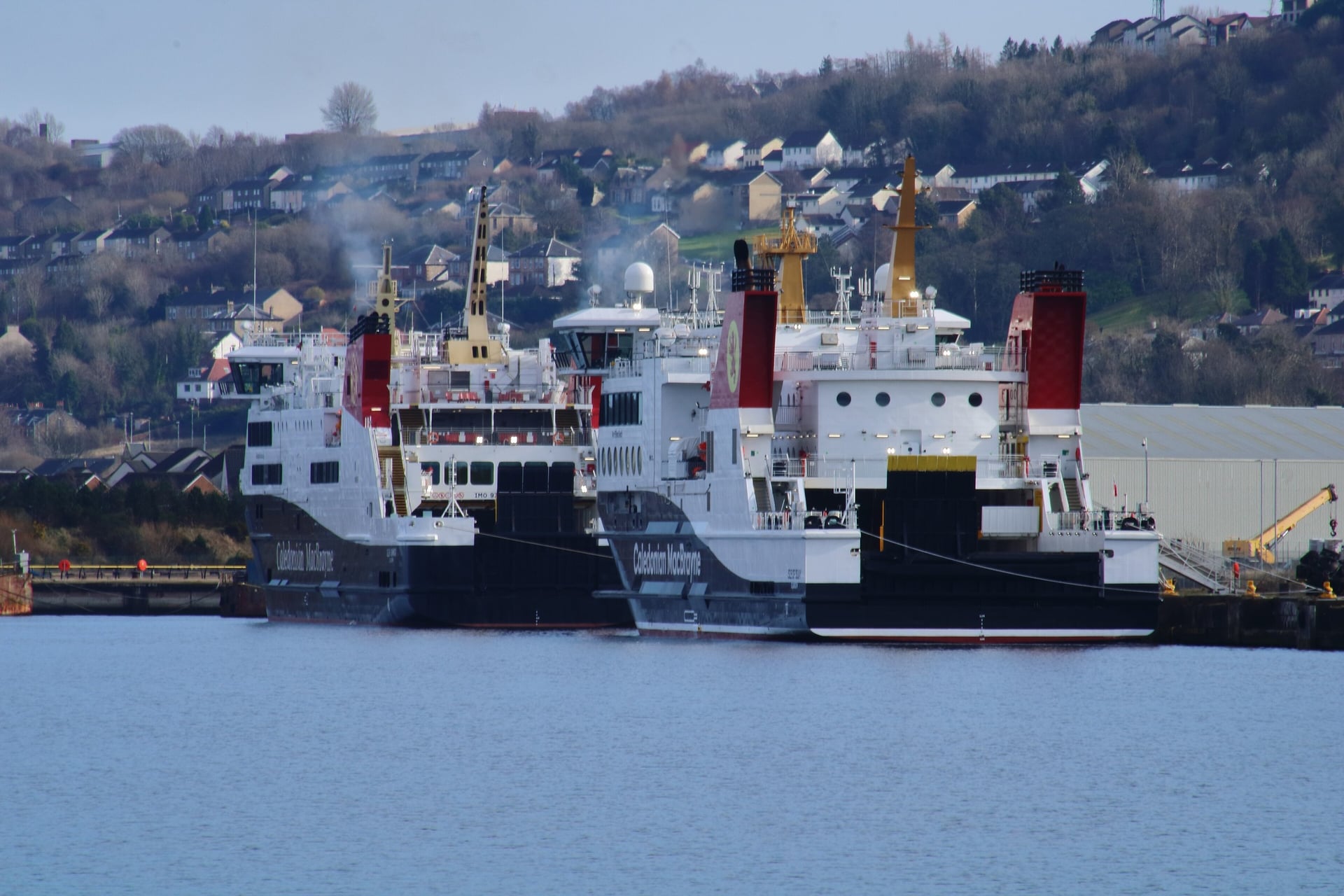
Arran ferry: £5.30 for an adult single from Ardrossan or Troon to Brodick, with the bike free
Oban to Castlebay: £19.70 for an adult single on the ferry to the start of the Hebridean Way
Corran and Camusnagaul ferries: £2 and £3.50 for a cyclist on the two Caledonia Way crossings
Hostel bed: from £24 at Loch Ness Backpackers in Drumnadrochit and £33.50 at Morag's Lodge in Fort Augustus
Bike hire: £45 a day, or £120 for three days, for a hardtail or touring bike at Nevis Cycles in Fort William (2025 prices)
Urquhart Castle: £14 for an adult booked online
What to Pack
Scottish weather can turn wet and windy within an hour, and Fort Augustus gets rain on about 14 days in July, so pack for rain in every month.
For any multi-day ride:
Waterproof jacket and overshoes, a warm layer and full-finger gloves
Front and rear lights and a red rear reflector, which the Highway Code requires after dark (rule 60)
Spare tubes, a pump, tyre levers and a multi-tool
Phone with the GPX files, offline maps and a power bank
For these routes:
Low gears for the 20% ramps of the Bealach na Bà and the hills of Kintyre
Tyres of 40 mm or wider for the forest roads of the Great Glen Way, and a mountain bike for the Loch Ness 360
Midge net and repellent for still evenings from June to August
Cash in pounds for the Camusnagaul ferry and the Gatliff hostels
Which Route for Your First Scottish Cycling Trip?
For a first trip, choose a short point-to-point route, then solve its two problems: beds in villages with one inn, and moving your bags.
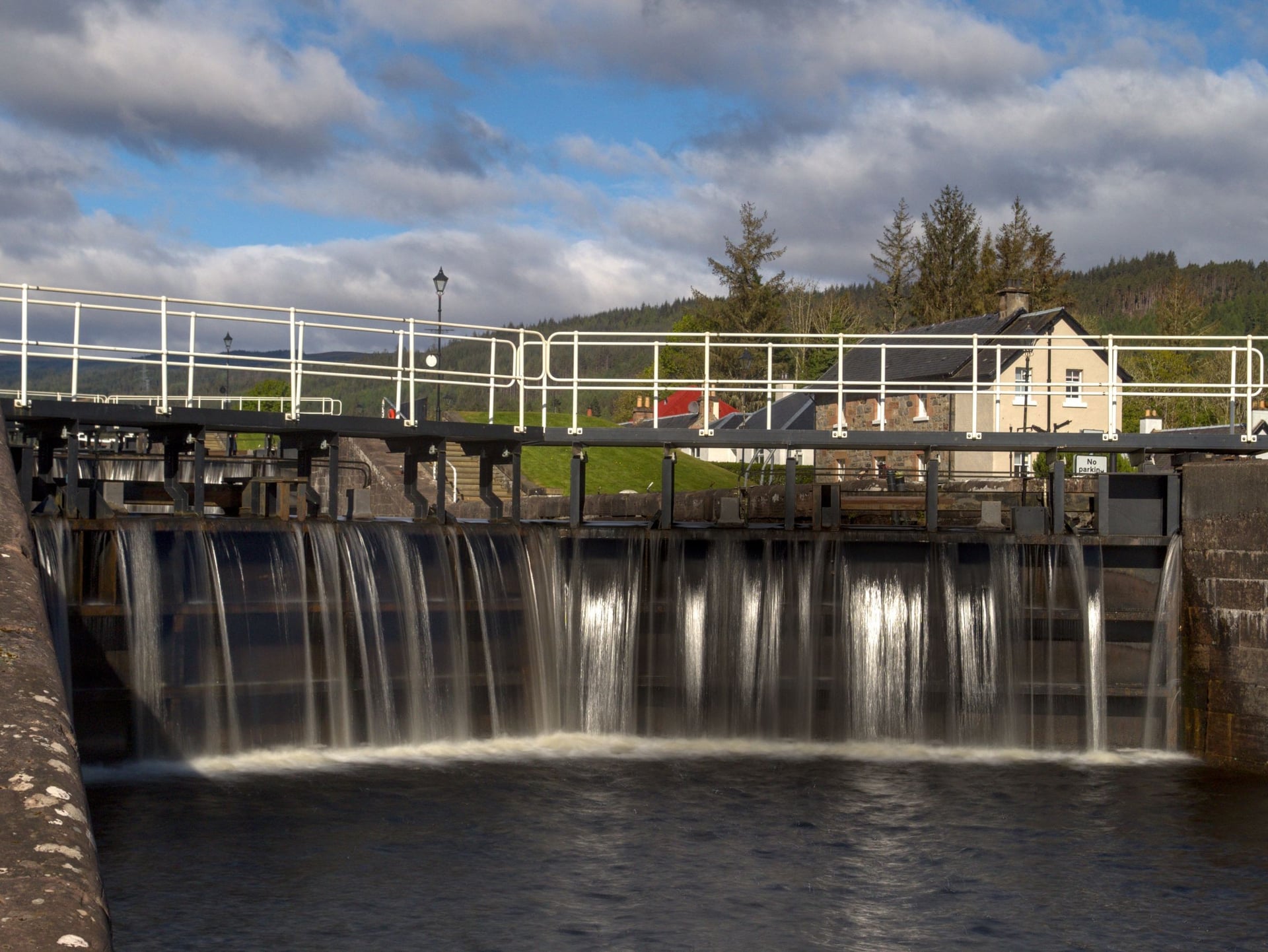
The Great Glen Way is the usual first choice, with three riding days from Fort William to Inverness, past the locks at Fort Augustus, and a station at each end. The Caledonia Way is the step up, and the North Coast 500 suits riders with a week of hills already behind them.
A self-guided tour books the nights before you leave, and a van moves your bags each day. Our four Scottish tours work that way:
Great Glen Way: Great Glen Way Bike Tour, 5 days / 3 riding days, Fort William to Inverness, 24 to 29 miles a day, May to September
Caledonia Way: Scottish Highland's Caledonia Way Bike Tour, 9 days / 7 riding days, Campbeltown to Inverness, May to September; it follows Route 78 to Fort William, then the Great Glen Way
Cairngorms: Cairngorm Cycling Holiday, 7 days / 5 riding days, Inverness to Dundee across the national park, May to September
North Coast 500: North Coast 500 Road Cycling, 10 days / 8 riding days, a loop from Inverness, May to September
Each tour includes the nights in 3-star hotels with breakfast, daily luggage transfers, a GPS app, a digital guidebook and support while you ride. Ask us about dates for next season.
Start with the Great Glen and you finish in Inverness three riding days later, where the Caledonia Way and the North Coast 500 also end and the Cairngorms crossing begins.
Frequently Asked Questions

Plan with a cycling expert
Free advice from a team that knows these routes inside out - real people, not a bot

Hassle-Free
We take care of route planning, accommodations, luggage transfers, and all logistics, so you can focus purely on enjoying your ride.

Tried & Tested Adventures
Our cycling routes are hand-picked & tested, to ensure breathtaking landscapes, smooth roads, and maximum safety - giving you the perfect ride every day.

Unbeatable Support
Our 24/7 customer support is where we show our passion, ensuring your cycling holiday runs smoothly and your well-being is always our top priority.

Book with Confidence
We are a financially protected company, fully bonded and insured, keeping your money safe and allowing you to travel with confidence.